

How To Draw The Meridian Plane Of Tresca Yield Criterion
How Do Mises and Tresca Fit In
 All mechanics of materials books have sections on forcefulness and failure criteria. Ordinarily the Mises and Tresca criteria are presented jointly with little discrimination or recommendation between them. What is more, often little else in the style of failure criteria are presented and the not-proficient reader tin be left with the impression that these ii criteria cover all or nearly all materials, and information technology doesn't greatly matter which one is used. Some books even grant these 2 criteria the status of being classical results. A full general question to be posed here is this, can either or both of these criteria be considered to be classical results or are they merely long standing, comfortable forms but of no special stardom.
This website has fabricated several references to the Mises benchmark while the Tresca criterion has barely been mentioned. In this side section a careful look is taken of the two criteria, mainly in comparison with each other to meet if at that place should be some inherent preference, even at this level. Concurrently, some observations will exist given of how each fits into the larger picture involving generality across just that of the usual ductile metals.
The chief interpretation of the Mises criterion is that it represents a disquisitional value of the distortional free energy stored in the isotropic material while the Tresca criterion is that of a critical value of the maximum shear stress in the isotropic material. Historically, the Tresca course was considered to be the more fundamental of the two, but the Mises grade was seen every bit an highly-seasoned, mathematically convenient approximation to it. Now, both are usually stated side by side with fiddling or no preference.
The 2 criteria are specified below in principal stress infinite. Both are one parameter forms, specified by either the uniaxial tensile strength, T, or the shear strength, Due south.
Mises Criterion , Critical Distortional Free energy

where
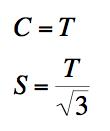
Tresca Benchmark , Critical Shear Stress
For the principal stresses ordered equally σ 1 ≥ σ ii ≥ σ 3 then

For the principal stresses not ordered
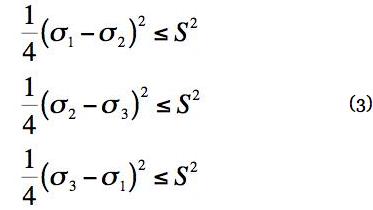
where
The three carve up forms in (iii) are for the maximum shear stresses in the three principal planes.
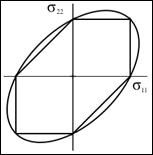
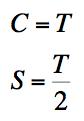
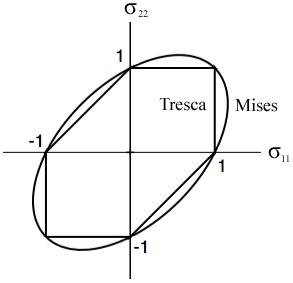
Both of these single parameter criteria can be calibrated on either T or S. The figures below, for biaxial stress states, calibrates both criteria on T and then on Due south.
Case I , Scale on T
Instance 2 , Calibration on Due south
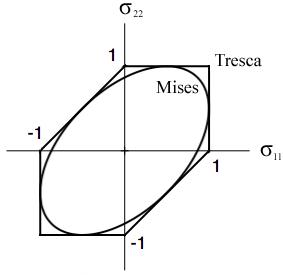
The maximum difference between the Mises and Tresca forms for both Cases I and II is fourteen.4%. The essential and striking differences between the two are the corners that occur in the Tresca class and their consummate absence in the Mises course.
Ii basic questions are immediately apparent:
- Which procedure is better grounded, calibrating on T or calibrating on S?
- Which criterion is more physically relevant, Mises or Tresca?
The steps of reasoning used here to answer these 2 questions are as follows:
- Calibrating on South might seem more logical because yielding is caused by distortional not dilatational states in ductile materials and distortion more than almost and hands associates with shear stress rather than with uniaxial tensile (or compressive) stress.
- Nonetheless, shear stress involves but one parameter and that does not naturally generalize to a two parameter course which is necessary for non-perfectly ductile materials. On the other manus, T=C naturally and automatically generalizes to T and C (T≠C) in the more general cases. So T and C, not Due south, is the natural combination that converges to T=C for a one parameter form. Instance Ii, calibrating on S, is appropriately rejected.
- With calibration by T, giving Case I, there is still the selection betwixt the Mises and Tresca forms. Mises is smooth, while Tresca has corners. At the crystal level (single grain) yielding does associate with dislocation move on slip planes. This is acquired by shear stress on the slip system (resolved shear stress). It would be tempting to say that this justifies and validates the Tresca benchmark. Simply that is just role of the "story". The status of isotropy implies and applies to polycrystalline aggregates with the individual crystals taking all possible orientations. Dislocation induced plastic catamenia occurs over many slip systems. Furthermore, dislocation pile-up occurs at the grain boundaries. The vastly more complex behavior at the aggregate level compared with the crystal level must involve averaging over a wide multifariousness of physical conditions and effects. This averaging has a smoothing effect that is much more than supportive of the polish Mises criterion than of the not-smooth Tresca form.
- Conclusions 2 and 3 back up and justify using the Mises (not Tresca) criterion for very ductile materials and calibrating on T (not S).
Farther relevant background considerations are equally follows. Tresca did do testing of metals that at the time seemed to support the maximum shear stress criterion. But that testing was superseded past the later excruciatingly conscientious testing performed by Taylor and Quinney and as shown in Section 6. The Taylor, Quinney results support the Mises criterion.
All T=C materials are metallic, polycrystalline aggregates. It is necessary to do orientation averaging to get the constructive isotropic moduli properties. It is a parallel and consistent circumstance that orientational averaging must as well be washed to get the forcefulness for polycrystalline aggregates. Mises (one) is consistent with this while Tresca (3) is not. Infact, Mises (1) is a limerick or a type of average of the iii split up criteria in (iii), Tresca.
The non-smooth behavior evinced by the Tresca criterion usually assembly with the competition of failure modes such every bit with a ductile flow fashion and a brittle fracture mode. Only those competitive effects are not present with ductile materials. Now consider a true 2-D type of continuum to see how information technology behaves. This is not plane stress or plane strain which are still iii-D behaviors. In this truly 2-D case it is found that a maximum shear stress criterion (Tresca) and a maximum distortional energy criterion (Mises) are identical, both giving polish behaviors with continuous first derivatives Then in going to 3-D the Mises class continues this smooth behavior but the Tresca form brings in corners. The Tresca beliefs in 3-D is an artifact of describing the maximum shear stresses in the three principal coordinate planes. This ignores the effects that occur at smaller scales in polycrystalline aggregates, and the averaging necessary to accomplish macroscopic beliefs.
Fifty-fifty though the maximum departure betwixt the Mises and Tresca criteria is but virtually 15% this departure represents a systemic mistake (divergence) on the part of the Tresca criterion and information technology should not be used for any isotropic materials, even for ductile metals. It is inappropriate to place the Tresca benchmark on the same level every bit the Mises criterion, as is done in most tutorial works. The Tresca criterion only merits a historical reference. This is consistent with the fact that the Tresca benchmark is the limiting case of the ii parameter Coulomb-Mohr criterion which itself is merely of historical interest. As discussed in Department VI the Mises criterion is the limiting case of a viable, completely full general, modernistic failure criterion. Despite its restrictions, the Mises benchmark is indeed a classical outcome.
Copyright© 2022
Richard Yard. Christensen

Source: https://www.failurecriteria.com/misescriteriontr.html
Posted by: myersounfee.blogspot.com
0 Response to "How To Draw The Meridian Plane Of Tresca Yield Criterion"
Post a Comment